Everyone's got an opinion on where to use AI in your business. Most of it is generic, borrowed from a LinkedIn post about a different business than yours. Here's the actual method I use, not the theory.
Start with the leak, not the tool
The honest answer to "where should I use AI" is: it depends entirely on where your specific business leaks time and money, and nobody can tell you that from a listicle. I build custom AI systems for a living, and the first thing I do with any business, including my own, is find the leak before I touch a single tool.
The ranking method
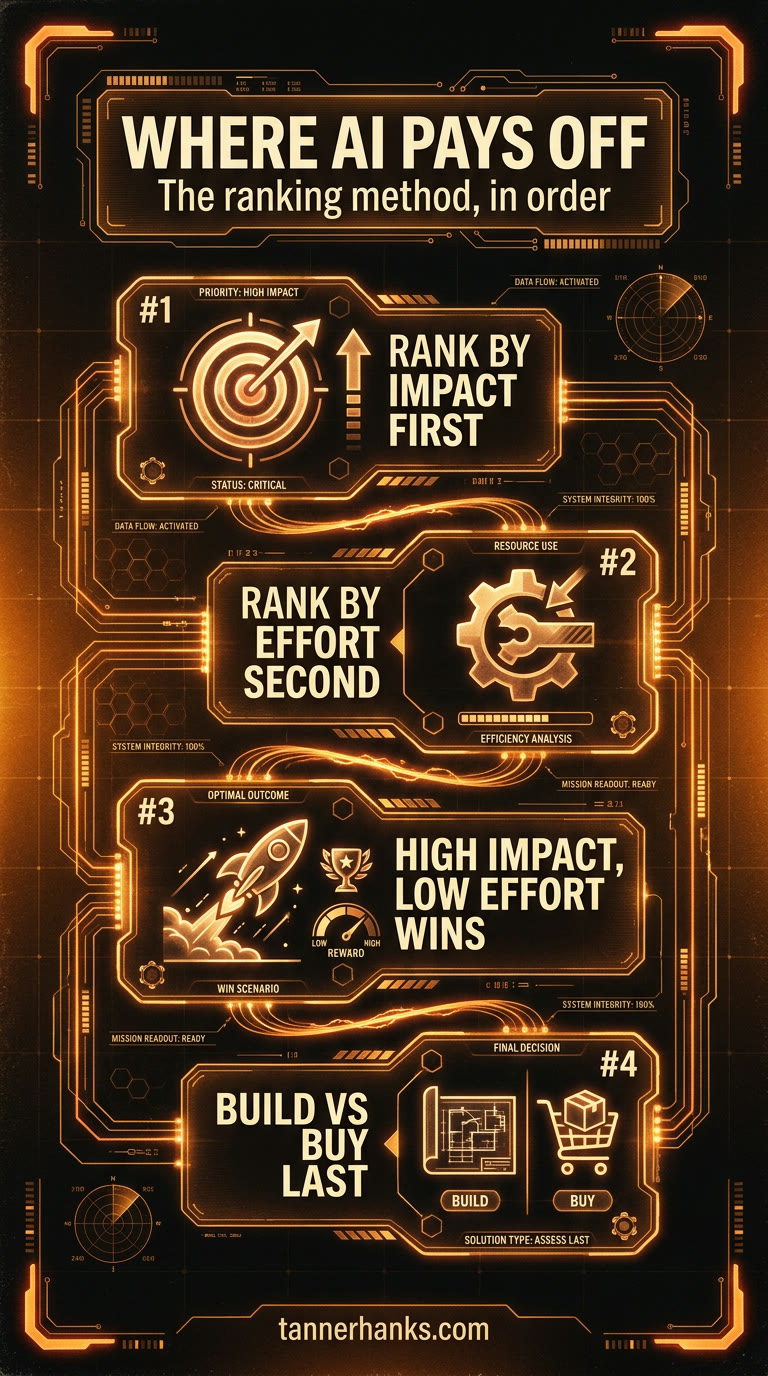
Here's the ranking method, in plain terms. First, impact: what would actually move revenue or free up real hours if it worked. Second, effort: how hard is this to build or buy relative to what it's worth. A play can be high-impact and still be the wrong first move if it takes six months to stand up. The plays that win are high impact, low effort, in that order.
Most businesses have three or four of these sitting untouched. Almost none have ten.
Build versus buy
The other half of the method is build versus buy. Some of what you need already exists as a tool you can turn on this week. Some of it needs a custom build because your operation doesn't run like anyone else's. I built Donna, my own AI chief of staff, because nothing off the shelf matched how I actually think and dispatch work. That was the right call for me. It's the wrong call for plenty of businesses that just need one good integration.
Where the Leverage Map fits
This is exactly the process behind the AI Leverage Map. In 48 hours, I look at your actual operation, rank every real AI play by impact and effort, and hand you the one move to make in the next 30 days. You keep the map whether or not you ever hire me again. No revenue promises, because anyone who guarantees those hasn't looked at your business yet.
Don't start with "what AI tool should I buy." Start with "where does my business actually leak," then work backward to the tool. That order is the entire difference between AI that pays for itself and AI that's just expensive novelty.